
Across telecom, AI is moving beyond an analytical layer and becoming part of the operating model. McKinsey’s Telcos’ AI inflection point: What leaders do to capture value argues that capturing value from agentic AI will require organisation-wide redesign, not isolated use cases.
Gartner’s forecast on agentic AI and one-to-one customer interactions predicts that, by 2028, 60% of brands will use agentic AI to facilitate streamlined one-to-one interactions. It also underlines the need for stronger data governance, transparency and operating-model adaptation.
Why campaign-centric models are reaching their limits
Even when insights are available, turning them into campaigns takes time. By the time execution begins, the context may no longer be relevant.
Data, analytics, business rules and execution systems often function independently, creating a disconnect between what is known and what is acted upon.
Campaign design, segmentation logic and execution workflows rely heavily on manual intervention, constraining both scale and speed.
Together, these constraints create a persistent execution gap: intelligence cannot be operationalised at the speed the customer moment requires.
Continuous revenue orchestration does not eliminate campaigns; it changes the default mode of engagement. Instead of asking, ‘What campaign should we run this week?’, operators can ask, ‘What is the optimal action for this customer, in this moment, across the lifecycle?
This shift introduces a different operating model:
Traditional CVM
Campaign-driven
Periodic execution
Segment-based
Human-led orchestration
Batch processing
Emerging Model
Decision-driven
Continuous execution
Context-based
AI-led orchestration
AI-led orchestration
Campaigns remain useful for planned propositions and broad-based communication. The difference is that always-on decisioning can respond between campaigns, whenever a relevant signal or intent emerges. In this model, the unit of execution is no longer only the campaign. It is the moment.
AI agents enable continuous monitoring, decisioning and execution across the customer lifecycle. In a telecom environment, they can:
This is governed autonomy, not unconstrained automation. Eligibility, consent, contact policy, budget and explainability remain explicit controls.
What leading operators are beginning to prioritise
Operators moving in this direction are prioritising four foundational capabilities:
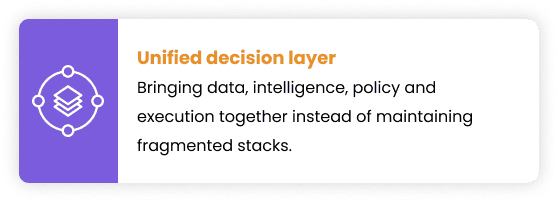
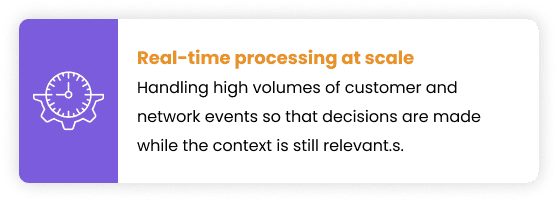
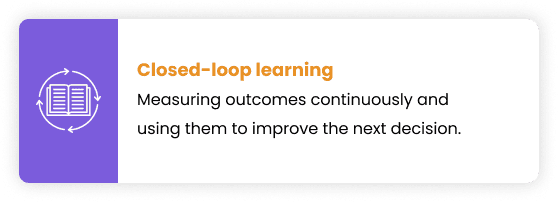
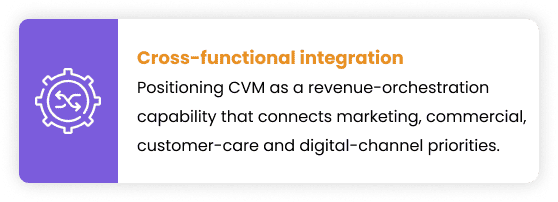
This shift requires an architecture that connects customer intelligence, decisioning and execution. mViva Revenue Acceleration Platform™ is designed as that continuous revenue-orchestration layer.
This moves CVM from reactive execution towards proactive decisioning, and from isolated AI use cases towards an AI-driven operational core.
The value of continuous revenue orchestration is measured in commercial outcomes:
Real-time signals and reusable decisioning reduce campaign setup cycles and accelerate execution.
Context-aware actions improve relevance and customer response.
Automated orchestration allows teams to focus on strategy, propositions and experience design.
Interactions become timely, relevant and consistent across channels.
Together, these capabilities improve how operators convert customer intelligence into measurable revenue and retention outcomes.
Serving more than 80 million customers, Grameenphone uses mViva Revenue Acceleration Platform™ for campaign management and loyalty management. The case study records measurable gains in revenue, retention and execution:



Campaigns will continue where planned, broad-based communication is appropriate. Increasingly, however, they will be complemented—and in time-sensitive journeys, superseded—by continuous decisioning, real-time orchestration and AI-assisted execution.
The opportunity is an always-on revenue model in which customer value is created through a coordinated stream of relevant interactions, rather than only through periodic campaigns.
If continuous revenue orchestration is a priority on your roadmap, the starting point is to connect data, decisioning and execution around measurable business outcomes.
Connect with our experts to explore how mViva RAP™ can help your organisation evolve from campaign-led execution towards an AI-driven, continuous revenue system tailored to your network, scale and commercial priorities.